Friday, January 26, 2018

Colors and Forms of Petrified Forest and Painted Desert

Dennis already posted several lovely photos of the Painted Desert and Petrified Forest. But I wanted to share a few more. This area of Arizona left an indelible impression on me four decades ago when a group of art and photo students from Valparaiso University took a two-week traveling photographic workshop over senior year spring break. Professor George Strimbu was a saint to lead this motley crew across the west and back in a 40 ft. motorhome.  I only saw a small portion of the Painted Desert back then, and what photos I took were mostly black and white. Dennis and I were eager to explore this area as it was his first time there.

Areas of the Painted Desert and Petrified Forest areas have an “other worldly” look to them just like the South Dakota Badlands, only with more colorful layers. The national park website describes these colorful layers as pages in a massive book. The first chapter of this geological text is the Chinle Formation. The Chinle Formation was deposited over 200 million years ago during the late Triassic period.

Rosy orange hills of the Painted Desert
A slice of the pink desert landscape
Rocks perched on maroon-gray hills in the "forest"
Painted hills in the style of Georgia O'Keefe

In the Petrified Forest, I was enthralled by the jewel-like colors of the harder than granite wood. Here are a few examples to show the variation of color and texture from piece to piece.


Quarter placed on top edge for size
Subtle pink, tan and gray-green combo was unusual
White and blue quartz contrast with earthen colors

From large logs to stool-like chunks to small gravel-sized pieces, the landscape was sometimes strewn with these pieces. In other sections, it looked like the wood was strategically placed for effect.


Dennis for scale
Petrified log sitting atop an eroding hill
And during our first day visit, this inquisitive raven followed us around for a while.


There was evidence of ancient Puebloan cultures via petroglyphs on the rocks.

 These photos capture only small glimpses of this fascinating, magical, historical park. If you haven't been, we highly recommend a trip. The northeast part of Arizona has many beautiful places to explore. We didn't make it to Canyon de Chelly National Monument this trip, but we will be back. Canyon de Chelly is one of the many memorable places I recall visiting on that traveling photographic workshop during college.


Tuesday, January 16, 2018

Painted Desert and the Petrified Forest

We spent the two days wandering the two adjacent, intermingled wonders that are the Painted Desert and the Petrified Forest. Founded in 1906 to stop the looting and development, they are strange and fascinating to behold.

We parked Harvey in a very nice KOA in Holbrook, Arizona. It was nearly a four-hour drive from Apache Junction to Holbrook. Not a bad drive; some high curves and a lot of steep inclines and declines. After passing through a pine forested pass about 6,800 ft. we stopped in a small cluster of filling stations at the junction of two highways. Once outside the cab I was immediately homesick for Scottsdale's warmth.

Over two days we walked about seven miles in the parks. All the walking was on paths: some recently paved asphalt, some old cracked asphalt and some tamped and trampled gravel. We climbed a total of maybe 20 floors worth of stairs and probably down just as many. There wasn't a scary step in the 18,000. Every ranger or employee we talked to was nice. Especially the rangers at the entrance gates. Our first day here was Sunday so it was a little busy. Today, a Monday, I think we could have sat there chatting a half-hour before anyone else wanted in.

Located east of Holbrook there is a good twenty-eight mile asphalt road, running largely north to south with a hook at the top like a shepherd's staff, that takes you to the dozen points called out on the park maps. We started at the north entrance. Turning north off I-40, thru the entrance gate you hit the new, attractive visitor’s information center with a short film, exhibits, a knowledgeable ranger and a cafe that was offering lamb stew that day. We grabbed a turkey sandwich, a bag of baked chips, two iced teas - unsweetened, thank you - and hit the road. It loops further north and counterclockwise under the interstate and into the body of the park. The park is maybe 20 miles across and 35 miles top to bottom; 50,000 acres. Still, they say the painted desert covers a 120 by 60 mile area. 


The Painted Desert’s palette is limited. At one extreme is a very light warm gray found on crumbling popcorn rock. The palette grows darker to a middle gray topping many of the cones found throughout the landscape. There are pale sage greens and then warm tones from almost orange through terra cotta to deep rust reds. They call some of the grays “blue” but to us at best they were cooler grays. 

A panorama near the north end of the park (Click to expand)
This view is representative of part of the palette you see.
This view is representative of different areas.
Maureen noticed this outcropping looked
like a seated lion from our point of view
That is not to say the landscape is not impressive, it is. It layers and spreads that palette across cones, hillocks, bluffs, mesas, canyons and wide plains. As you move south through the park petrified trunks and chunks start to appear. By the time you are in the southern quarter you find long, massive trunks laid on pedestals of softer material they have protected from erosion. Some trunks protrude from sandstone faces like rusted ancient cannon. When the sandstone is eaten back enough an unsupported chunk of the trunk breaks off and slides or rolls down the hill. 

Panorama showing petrified logs just scattered about.


A large petrified log teetering on much softer material it has protected

Sometimes you see a sense of humor in the park designers.
Like these steps at Long Logs near the South Gate.

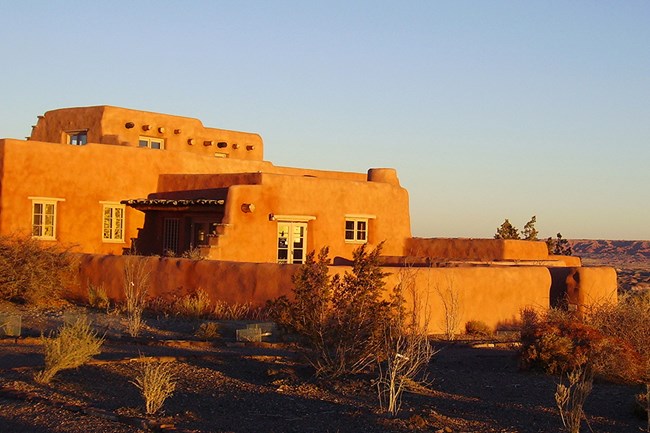
One of the northern stops is the Painted Desert Inn. It was built by a family around 1920 and registered under the Homestead Act in 1924. The stucco exterior and other changes were made by Civilian Conservation Corp workers in the 1930s. That touched me because my grandfather, Skelie Sanner, worked on the CCC. The interior showed craftsmanship and an interesting variety of materials.

Historic Painted Desert Inn glows in the light of sunrise
This is the Painted Desert Inn in the park.It has seen many changes in its almost 90 years (National Park Service photo)
A main room in the Inn with a ceiling of decorative glass panels.

This petroglyph was found in the park separated from its original substrate.

In much of the Inn the ceiling is made from herringboned
aspen logs laid over Ponderosa pine beams
The colors of the petrified wood are varied and sometimes intense. They seem to include all colors except blue. Iron in its ferrous or ferric states make up many of the colors. The visitors and museum shops offer polished fragments, slices, slabs and sections of trunks from a few dollars to several thousand. There are also privately owned shops nearby selling “petrified wood.”We didn’t go in. At first I was irritated thinking they must be stones pilfered from the park, but, the park only covers a small percentage of the entire petrified forest area. All of that being wood cut, polished and sold could be from private or unprotected public lands. Still, no one piece is definitive and what do I need with a chunk of wood/stone?
This is a large polished slab over 3 ft tall.
Petrified wood is four times harder to work than granite.


The white areas are often quartz.


Quartz in the center.

"The Agate House" rebuilt after a dwelling by the native inhabitants.
Typical of cliff dwellings and other stone structures it is entered
via a ladder through a hole in the roof.

It was hard deciding what to photograph. And, many colorful petrified pieces were too far off the path for a casual visit. Still, there were plenty. We intensified the colors of some by pouring RO-filtered water on them before taking a photo. Some trunks were 100 feet long and six feet or more in diameter at the base. A placard in the park said when they were alive in the time of the dinosaurs some were 200 ft tall. 


We were there in the winter, still some plants were blooming.
There are 1800's photos of Victorian couples standing on this 100 foot petrified log.
Some time early this century they added a crude concrete reinforcement.  

We couldn't get the full dozen spots done in one day and so went back to Holbrook to eat at Romo's. Just off the main street it was friendly, cozy and inexpensive. The food was good and plentiful and the beer was cold. The salsa was just spicy enough, as were M's chicken enchiladas. I had the Navajo Taco, which was tasty and mild. Couldn't ask for anything else for an early dinner after a day of tramping around the parks.


Cold Out There and In Here

We started in this tour of western National Parks in early September. It wasn’t hot most days, but it was wonderfully warm. We, Maureen and I, are very susceptible to cold. There were nights in mid-September in South Dakota and Wyoming when we had flannel sheets, a blanket and the bed spread over us. She wore wool socks to bed. We were still cold, but then we could not get the furnace in the RV to work. We were miserable. It’s, to me, absolutely amazing how cold 58º can feel when you roll out of bed in the morning for that first cup of coffee and how warm 58º feels in the Spring.

After that we fixed a few things and traveled into the mountains and deserts. We had a lot of nights when it was very hot and in the day we covered our windows with bubble-wrap coated on both sides in foam (Reflectix) to reflect the sun. Those nights we put away the flannel sheets and brought out the polished cotton and ditched all the blankets and covers. But we were comfortable, in fact happy, being what other people would call ‘hot.’

For four months we have been in sunshine. We noticed we had only been in rain, in the daytime, once in southwestern Colorado, driving into Norwood. It’s rained, a little, two nights since then and that’s it. Most of our time has been in the brilliant southwestern sun. Gorgeous. Our moods have been consistently upbeat and we have gone out to walk, hike, jog in every location. 


Now it is mid-January and after 7,000 miles of driving we’ve left the glowing pleasures of San Diego, Joshua Tree, Phoenix, Scottsdale and Tucson for the high mesas of New Mexico. Driving from Santa Fe to Roswell today for a few minutes we had a heavy mist from low, leaden clouds. It cleaned the windshield so we could more clearly see nothing but desert to each horizon: dead flat to rolling, coated in short grass and dark, scrub shrubs. 


At night we have to disconnect the water hose, lest it burst. This morning, before I reconnected it, I ran water through it. Out shot two-inch ice slugs that lay intact in a mass in the weak sun on the dead grass outside the RV until we left two hours later. 


In Oroville, California we lay under the RV for two days attaching heating pads to the black water and gray water tanks, wiring them through switches into the circuit breakers inside and wrapping any exposed wires or pipes to protect them from cold and abrasion. We hope they work. If they don’t we’ll be leaking bio-hazards on our site and, if unnoticed, down the roads. 


We like to RV. It’s fun. We get along well in this tiny space. We’ve seen beautiful places, challenged ourselves with heights, enjoyed glorious sunsets and wondrous starry skies and (thanks to Maureen) had some great meals out in the middle of nowhere. But, it’s going to be eighteen tonight. We’re sitting inside with fleece quarter zips and booties on, the thermostat set at 64º, two ceramic space heaters blowing (to save propane) and hoping, really hoping, nothing breaks that forces us outside. M will wear a wool cap in bed tonight.

We’ll be home in a month, mid-February. March is really the end of Winter in central Indiana. Our plan is to sell the RV and return to more stationary lives, re-involve ourselves in things that we think matter. But, in the warm, in spring and summer, I know I will feel the urge to do this again. In winter, no thank you. 

Sunday, December 31, 2017

Reno & Lake Tahoe

Visiting friends.  After two successful careers and a lot of smart real estate moves they have a lovely home in Reno and a home-sized 'cabin' outside of South Lake Tahoe. They also have three rescued Maltese. One the quiet, shy matron who, in the equivalent to human age, is in her mid-70s. The second, a male, who judging by his actions, thinks he's 20 times his actual size. The third is tiny, even for a Maltese. She's the equivalent of a teenager; a shy, gentle teenager.

Maureen, Fredy II, Rebecca, Tiffany and Phil
Along Lake Tahoe, every view was wonderful, even on a gray day.

Smooth as glass, cold as ice.

Tahoe's muted winter pallet.

Lake Tahoe panorama

Tiffany, the shy teen

Fredy II - who thinks he punches over his weight.